The Future of 3D Printing: Trends, Innovations, and Applications

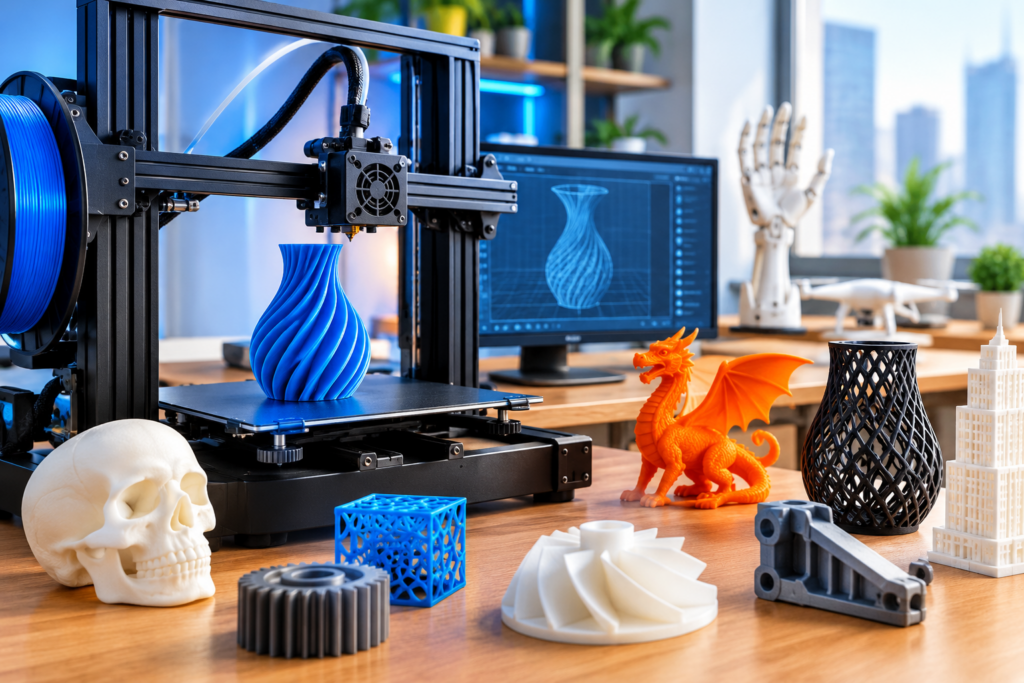
3D printing has become a transformative technology in various manufacturing fields, such as healthcare, construction, aerospace, automotive, education, and product design. 3D printing, also referred to as additive manufacturing, is a process of manufacturing items by building them up from a computer-generated design. The technology is growing and is creating new opportunities for businesses and consumers alike, with printer speeds becoming faster, materials advancing and software becoming smarter.
Automation, sustainability, advanced materials, customization, and large-scale production are anticipated to be key trends in the future of 3D printing. Such advancements have the potential to make additive manufacturing a growing aspect of the industry today.
The Evolution of 3D Printing Technology
The initial 3D printing machines were primarily used for prototyping and simple modeling. This allowed companies to develop a physical sample of a product without incurring costly manufacturing procedures. This assisted designers in the identification of issues, testing of shapes and product enhancements more efficiently.
Modern 3D printing technology can provide functional parts made from special materials and, increasingly, with higher precision. Different industrial needs are served by technologies like Fused Deposition Modelling (FDM), Stereolithography (SLA), Selective Laser Sintering (SLS), and metal AM.
The technology is thus going from prototyping to end-use production and custom manufacturing.
Faster and More Automated 3D Printing
The automation trend is one of the most crucial trends in the future of 3D printing. Manual preparation, monitoring, support removal, and post-processing are required steps for traditional 3D printing. These tasks are being minimized in newer systems with automated workflows.
Machine learning and artificial intelligence can also be used to keep track of printing conditions and determine potential defects. Smart software can measure the printing speed, flow of material, layer quality and more.
As automation progresses, businesses could potentially have to manage larger fleets of printers, with fewer manual steps. This might enhance productivity and make additive manufacturing more viable in commercial production.
Advanced Materials Will Expand Applications
Materials are at the heart of the future of 3D printing. Plastics continue to be in demand; but manufacturers are using more composites, ceramics, resins, metals and other specialty materials.
The properties of an advanced material can include toughness, resistance to heat, flexibility, resistance to chemicals or a light weight. This is especially vital in industries where parts need to have rigorous technical specs.
For instance, in the aerospace and automotive industry, lightweight printed parts could contribute to lowering the weight of the final product. In the medical field, specialized materials can aid in creating personalized medical devices and other uses.
Greater Personalization and Custom Manufacturing
One of the greatest benefits of 3D printing is the ability to produce one-of-a-kind goods without the need to use conventional moulds or specific tools for each design.
Personalisation may become more prevalent in various industries in the future. Your customers might be able to order custom made items based on the details of their body, taste or need.
A good example is healthcare. Digital scanning and 3D modelling can be used to make tailored prosthetics, dental products, medical models, surgical models, and more. Rather than creating same-for-all products, manufacturers have more ways to digitally create products for specific needs.
Sustainable Manufacturing and 3D Printing
Another key consideration in the future of Additive Manufacturing is Sustainability. Conventional production techniques can include material removal from larger blocks such as cutting, drilling etc. 3D printing, on the other hand, adds up the layers of material as it prints the thing and can decrease material squander for an appropriate application.
The technology could also facilitate local and on-demand manufacturing. Companies would not stockpile large amounts of physical goods, but rather keep digital blueprints and only manufacture desired products as necessary.Businesses would be able to keep the digital blueprints for their products and only manufacture what they wanted when it was needed, rather than storing large amounts of physical goods.
But, 3D printing isn’t a sustainable process per se. The following must also be taken into account: energy consumption, material production, failed prints and post-processing. There is likely to be a greater emphasis on the use of recyclable materials, energy-efficient printers, production process improvements, and waste management in the future.
3D Printing in Construction
The construction industry is experiencing new opportunities with large scale 3D printing. Specialized printers can lay construction material to specifications based on a digital design, which in some cases can minimize some of the more labor-intensive operations.
Further developments for the construction industry may involve the development of tailor-made building parts, architectural elements or even parts of buildings. Use of the technology might enable the fabrication of complex shapes that would be more difficult or costly to make with traditional methods.
Further research and companies are still investigating ways to use construction 3D printing to solve issues regarding costs, materials, construction speed, and housing need.
Healthcare Applications will keep on expanding
Another area with great possibilities for 3D printing is healthcare. 3D models are valuable for medical professionals to better understand anatomy and prepare for complex procedures. Digital manufacturing can also be used to create customized devices and prosthetics.
Bioprinting is a new area that delves into the use of specialized printing techniques and biological materials to generate tissue-like structures. While there are many more complex applications being developed and researched, ongoing advancements may help expand the use of AM in the medical field.
Innovation in the Aerospace and Automotive sector
The aerospace and automotive sectors are also embracing AM due to the opportunities it presents for lightweight, complex, and custom-made parts.
For engineers, 3D printing is an excellent approach to creating geometries that might be challenging to fabricate with different methods. In the field of aerospace, weight can be a critical factor in reducing the weight of components, which affects the performance of aircraft and spacecraft.
Other applications for automotive companies include prototypes, tooling, replacement parts, customised parts, and some production applications.
The Role of Artificial Intelligence
AI is likely to be increasingly integrated with 3D printing. AI can help optimize designs, identify defects, manage production, and predict maintenance issues.
This generative design can yield several design solutions, depending on the requirements such as weight, strength, material use, etc., and manufacturing constraints. The addition of these capabilities to additive manufacturing can allow engineers to investigate more complex designs more efficiently.
The association of AI, digital design and 3D printing could prove to be one of the most significant technological advancements in the industry.
What lies ahead for 3D Printing?
More speed, automation, material variety, customisation, and integration with digital technology will likely be the hallmarks of the future of 3D printing. Given the trend for costs to come down and systems to become more capable, additive manufacturing could prove to be a solution for a broader set of applications.
3D printing is unlikely to supplant traditional manufacturing, but instead to complement the existing methods. Design flexibility, customization, rapid development and on-demand production are its greatest strengths, which are especially beneficial when dealing with certain manufacturing problems.
3D printing is still evolving and transforming the way products are designed and made, ranging from personalised healthcare products to advanced aerospace parts and eco-friendly manufacturing processes. With the advancement of technology, it may have an even greater role in manufacturing in the future.