Edge Computing vs Cloud Computing: What is the difference, what is similar, and more?

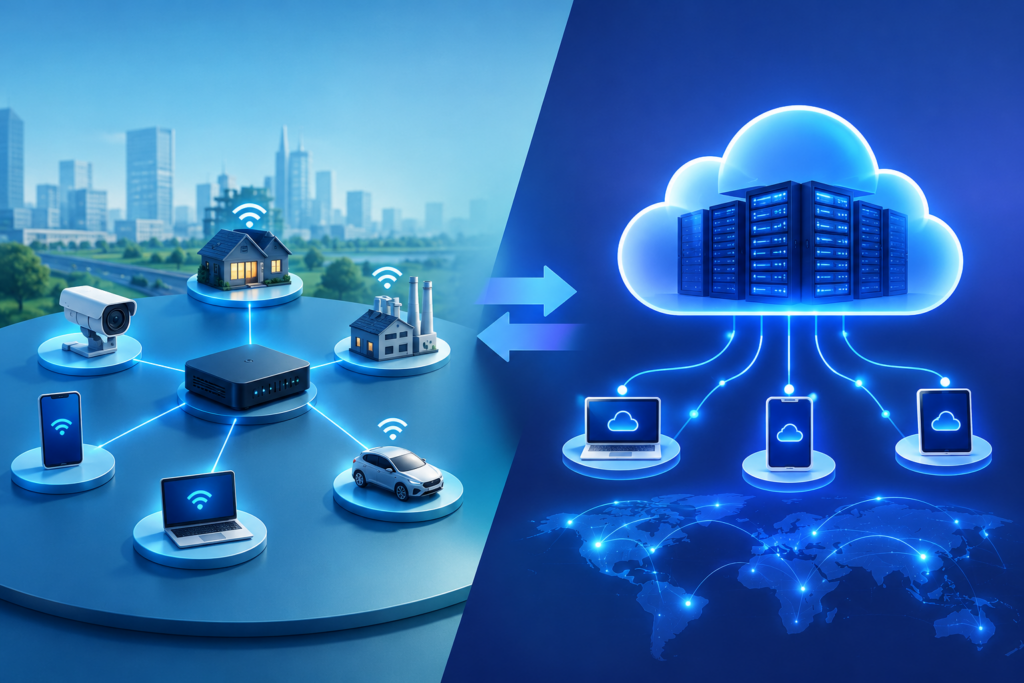
Edge Computing vs Cloud Computing are two distinct methods of computing and processing data with their distinct advantages and disadvantages. Edge-based processing ensures low latency and low bandwidth consumption by processing data locally for immediate use, while cloud’s resources and remote access offer flexibility and power for processing large volumes of data over longer periods and for analysis.
The difference is important as it can affect data speed and data control. So, getting a detailed understanding on both edge and cloud computing is important to optimize IT infrastructure and make the best use of both.
This article highlights the key comparisons between edge computing vs cloud computing, their similarities, pros & cons, and use-cases to help you make an informed decision.
What is Cloud Computing?
It is an altogether new paradigm for the use and access of IT resources. It is the convenient delivery of technology services over the Internet without investing in the infrastructure such as data centers and servers.
What is Edge Computing?
It’s a new paradigm for information delivery to users that’s based on a set of networks and devices in and around the user. It is all about processing data at the point of creation, hence processing faster and handling more information. This fast processing allows to take faster actions and obtain immediate results.
Difference Between Edge Computing and Cloud Computing
These are both very important aspects of the digital ecosystem. The disparities in processing location, latency, scalability, use cases, security and reliability serve different industries and organization needs and applications. Therefore, let’s dive into the detailed difference between cloud computing vs edge computing:
Location of Processing
Cloud Computing: Under this technology, data is processed in the central data center remotely managed by the cloud service provider. These data centers can be located in various geographic areas, and provide services for users all over the world.
Edge Computing: It is a distributed computing paradigm that performs computation near its source, usually on local devices or servers at the edge of the network. This minimizes the distance data has to go, making it quicker and reducing latency.
Latency
Cloud Computing: Latency may be greater because data needs to move back and forth across networks due to the physical separation of users and data centers.
Edge Computing: Processing the data closer to the data source results in much lower latency. This helps to achieve faster responses, a requirement for real-time applications.
Scalability
Cloud Computing: It provides users with huge scalability they can request resources as they need. Cloud services are capable of handling a lot of users and data.
Edge Computing: This type of computing can be agile but may be limited in terms of scalability due to various factors, including the resources available at the edge devices or servers. It may need more infrastructure to be deployed at several edge sites.
Use Cases
Cloud Computing: It is best for applications that need lots of computational power, lots of storage, and can be accessed from anywhere with an internet connection. Mostly, the uses are big data analytics, AI/ML processing, and application hosting.
Edge Computing: Fog/Edge Computing works well for applications where there is a need for low latency and real-time processing. This can be used in applications such as remote monitoring systems and IoT sensors & smart devices.
Data Security and Privacy
Cloud Computing: It is about centralized data storage and can be a legitimate concern about data security and privacy. While these are all concerns, cloud providers have strong security measures in place to protect stored data.
Edge Computing: The data that is processed at the edge can enhance security by minimizing the need to transmit sensitive data to distant servers. But getting a lot of edge devices is not without its challenges.
Reliability
Cloud Computing: Overall, this computing model provides high reliability with the help of redundant systems and backups in data centers.
Distributed Systems: Edge systems or edge servers may not be as reliable as each other based on their quality and maintenance. In this way, it is important to guarantee stability in such distributed systems.
Comparisons of Cloud and Edge Computing
Although they differ in their style of approach, they have some key similarities. Edge and cloud computing share the goal of improving access to and scalability of information and its efficiency. The similarities give clues as to how these two approaches can work together, and how this can lead to a more effective and rich computing environment.
The Advantages and Disadvantages of Edge Computing
The decision to use cloud or edge computing will depend on the operations and preferences of your organization. Take into account factors such as latency, data sensitivity, budget considerations, and the complexity of the application when making your decision. Let’s get into the nitty-gritty of edge computing, the advantages and disadvantages, and then help you decide which is right for you.
Pros
Low latency
While the traditional approach creates delays in data processing, the advantage of edge computing is dramatically reducing the delay for information to move from a central server to and from the edge, which is crucial for real-time applications such as autonomous vehicles and industrial automation.
Reduced bandwidth
Transferring massive amounts of data to and from the cloud can be costly in terms of bandwidth usage, resulting in potentially high Internet costs. Edge computing technology can greatly decrease bandwidth consumption by filtering and processing the data near the source, and only transmitting the necessary data to the cloud. This can lead to significant cost savings, particularly for businesses with high data volumes or those generating data.
Enhanced data protection and privacy
By reducing the amount of data transmitted and processed in the cloud and keeping the sensitive data on-site, edge computing helps in minimizing the risk of breaches and leaks in centralized cloud servers.
Offline functionality
All organisations strive to run without interruptions in remote or separated settings. This computing approach provides the same functionality to you. You can use your connections and devices even if the connections are lost. Useful in emergency situations or for work in an isolated location.
Decentralized infrastructure
Edge based processing is a decentralized approach in which processing power and storage capacity are spread out among smaller, localized nodes, that are near the data source. This results in a more resilient system to failures in any one location due to the distribution of processing and storage.
Cons
Limited resources
Individual edge servers have less processing power and storage capacity compared to the vast computational power and storage capacity of centralized cloud servers. This limits the complicated computation or storage of huge data on this computing platform.
Higher upfront costs
Establishing and maintaining edge infrastructure can be costly since it involves a distributed infrastructure, specific hardware, and network upgrade. Therefore, it is recommended that a careful analysis of cost and benefits be done relative to the application and its specific requirements prior to selecting any of the computing platform options.
Security management challenges
With the increasing number of endpoints in edge computing devices across different locations, maintaining high security levels becomes difficult. Therefore, it is difficult for edge computing devices to include strong security features such as encryption, intrusion detection and endpoint protection software.
Software compatibility issues
Edge devices can have varying software requirements (e.g., varying processors, operating systems, memory), making software development and deployment across all devices challenging. In edge computing, dealing with large deployments is a challenge.
Limited scalability
Scaling edge computing resources tends to be more intricate and costly than scaling cloud resources. This makes it difficult to scale and can slow down the performance when dealing with large amounts of data or heavy calculations.
Pros and Cons of Cloud Computing
The centralized computing approach provides unequalled benefits, including scalability, cost-effectiveness and centralized management and control. There are some disadvantages to bear in mind, however, in addition to these advantages. So let’s discuss the advantages and disadvantages of it and make sure your business decision on the transformative power of cloud computing is the right one.
Pros
On-demand scalability
One of its main advantages is its flexibility. Cloud resources can be easily scaled up or down according to the changing demands of your business. This flexible and agile cloud solution is cost-effective and efficient for your business.
High computing power and storage
The benefits include access to powerful servers as well as the ability to have a large amount of storage. With this ability, you can easily analyze large volumes of data and run applications on larger scale easily.
Centralized management and control
This computing approach help organizations with simplified IT management and enhances visibility with bird’s-eye view of their entire cloud environment. It makes it easier to manage applications and data from a single point throughout the system.
Automatic software updates
Regular software update and maintenance are done by cloud providers. This reduces downtime and also relieves the internal IT team from the load of working on the project and enables them to focus on other important tasks like business plans, key projects etc.
Cost-efficiency
Pay-as-you-go pricing model eliminates the need to make upfront investments in hardware and infrastructure, and pays only for what is used. This way, companies can make more effective budgeting plans.
Cons
High latency
Data and applications are stored on a remote server and accessed via the internet. Data moves to and from cloud, resulting in slow response times and not suitable for real-time applications.
Security concerns
Cloud computing is based on a shared responsibility model so the potential for vulnerability, cyberattacks and data breaches is a point of concern.
Vendor lock-in
Data migration is a complex and expensive process and can pose challenges when switching from one cloud service to another, as vendor lock-in can make the process difficult.
Potential hidden costs
There can be unforeseen costs associated with perks such as bandwidth usage, data storage, and particular services, affecting financial forecasting and adding to unanticipated financial obligations.
Explore the use cases of Edge and Cloud Computing
The two computing methods are transforming industries and creating revolutionary applications in healthcare, retail, manufacturing, finance and transportation. Let’s take a closer look at specific use cases and the way they can fully utilize the power of data, streamline operations and provide the end users with outstanding experiences.
Retail
Edge Computing: Powering smart cameras deployed at store doors with AI to rapidly process customer information. This helps to instantly adjust displays or create targeted promotions in real-time, improving the shopping experience.
Cloud Computing: In-store sensors gather in-depth product and customer data. This information is uploaded to the cloud for further analysis, enabling the best use of inventory and store layout changes to take place in line with wider trends and patterns.
Manufacturing
Edge Computing: Edge devices such as IoT sensors, smart cameras and IoT gateways mounted on factory machines are able to keep track of their performance as it happens. They actively identify possible faults, and can identify for predictive maintenance before problems occur in production processes.
Cloud Computing: The data that is collected from different machinery on the factory floor is collected and processed in the cloud. Through optimized operations, advanced analytics can be used to identify patterns that occur over a period of time and areas for improvement, thereby increasing production efficiency and economic productivity.
Healthcare
In the healthcare sector, edge computing enables hospitals and clinics to track patients’ vital signs through wearable devices, and automatically notify healthcare professionals when there is a significant shift. This is a real-time data transfer that is invaluable, especially in remote areas, where attention to the situation is of paramount importance.
Cloud Computing: Cloud computing is key to access and study imaging data and electronic health records (EHR) in the healthcare setting. This technology accelerates diagnosis, tailors treatment strategies, and fosters collaborative research efforts. Overall, it improves patient care and drives advancements in the medical field.
Transportation Industry
Edge Computing: This decentralized computing method enables autonomous vehicles to detect obstacles and avoid collisions in real-time. This helps them to be safer and more responsive on the road, as they are able to make real-time decisions.
Cloud Computing: Data from traffic cameras and sensors throughout the transportation network goes to the cloud. These data contribute to intelligent traffic management systems, helping to optimize traffic flow, alleviate congestion, and improve the overall commuting experience for all.
Cloud Computing vs Edge Computing: Which One to Use and When?
Organizations can choose between Cloud and Edge Computing based on their needs. Take the following into account:
- Edge-Based Processing: Edge-based processing is beneficial for latency-sensitive applications that need real-time responses.
- Data Sensitivity: Edge computing is ideal for sensitive data because of its ability to process data locally, providing better security.
- Scalability Needs: Cloud computing offers excellent scalability and flexibility in situations where it is important to be able to scale up or down depending on demand.
In some cases, it is best to leverage a combination of both cloud and edge technologies. That way you can reap the benefits of both and make things click, depending on the job or business, whether you are looking to be quick, scalable, and/or cheap.
Why Choose Rishabh Software for Cloud Application Development?
We are a strategic partner of organizations looking to leverage cloud technology. Our 20+ years of expertise enables us to craft comprehensive cloud strategies, design and build cloud architectures integrating components and using resources distributed throughout the network. This method will make sure that your cloud environment is efficient and effective.
Our full range of services serves businesses of all sizes, throughout geographies. From expedient integration with leading public cloud providers such as AWS or Azure to developing cloud applications from scratch, our understanding guarantees solutions that fit your specific necessities.
A certified AWS and Microsoft Azure service partner, Rishabh Software helps you develop and deploy cloud-native applications that utilize distributed computing, as per the cloud delivery model.
Frequently Asked Questions
Q: The best of both the Edge and the Cloud Computing?
A: It saves bandwidth since data can be processed near its source, minimizing delays due to Edge computing. In the meantime Cloud Computing provides enormous storage and processing power. Companies can combine both to use the fog/edge system for immediate data analysis and the cloud for storage, complex processing and long-term data analysis.
Q: The Future of Edge Computing & Cloud Computing for IoT?
Edge and cloud computing is most likely to be mixed in the future of IoT. Edge computing will take care of fast time-critical activities nearer to the point of operation, delivering quicker responses.
Complex analysis and long-term trends will be handled by cloud computing, while data storage will be handled by cloud computing. They will complement each other to provide a powerful duo for efficient and reliable IoT operations.
Q: How does Cloud Computing Work?
A: Cloud Computing is a virtual processing/storage centre. It isn’t only for your device; it uses remotely connected internet computers to store data and execute applications. Your device connects to these servers over the internet, and you can run software and store data, and do things on your device without needing lots of powerful equipment.
Q: How Does Edge Computing Work?
A: It is about reducing data processing to closer to where the data is generated, as opposed to a central location.
Data is processed on the edge device on-site, as opposed to sending all data to a distant data center, thus reducing the need for sending data. This leads to quicker response times, less data transfer, and efficient time-sensitive tasks.